Sass Lighting
Wet areas demand more than a bright bulb. Water, steam, splashes, and condensation can reach fittings in bathrooms, kitchens, patios, and outdoor walkways. So, how do waterproof bulbs work in wet areas? They combine sealed housings, protective gaskets, corrosion-resistant materials, and carefully designed electrical connections. These features help keep moisture away from energized components while preserving reliable illumination.
The most important detail is often the fixture, not the bulb alone. An experienced installer checks the product’s IP rating, installation location, ventilation, and manufacturer instructions before switching it on. For example, a sealed bathroom fixture may use a rubber gasket around its lens, while an outdoor fitting may include a threaded cover and drainage design. Some systems operate at lower voltage, reducing certain electrical risks, but they still require correct installation.
Waterproof does not mean indestructible. A damaged seal, loose cover, or cracked lens can weaken protection quickly. Even a small gap may allow humid air inside, where condensation forms on metal contacts. That hidden moisture can cause flickering, corrosion, or premature failure.
This guide examines ten practical explanations for how these bulbs function in wet environments. It also considers IP ratings, heat management, material quality, maintenance, and common installation mistakes. Real-world performance depends on the complete lighting system. That part is easy to overlook. Careful product selection matters, but regular inspection matters too. Where guidance seems unclear, consulting a qualified electrician remains the more reliable choice.
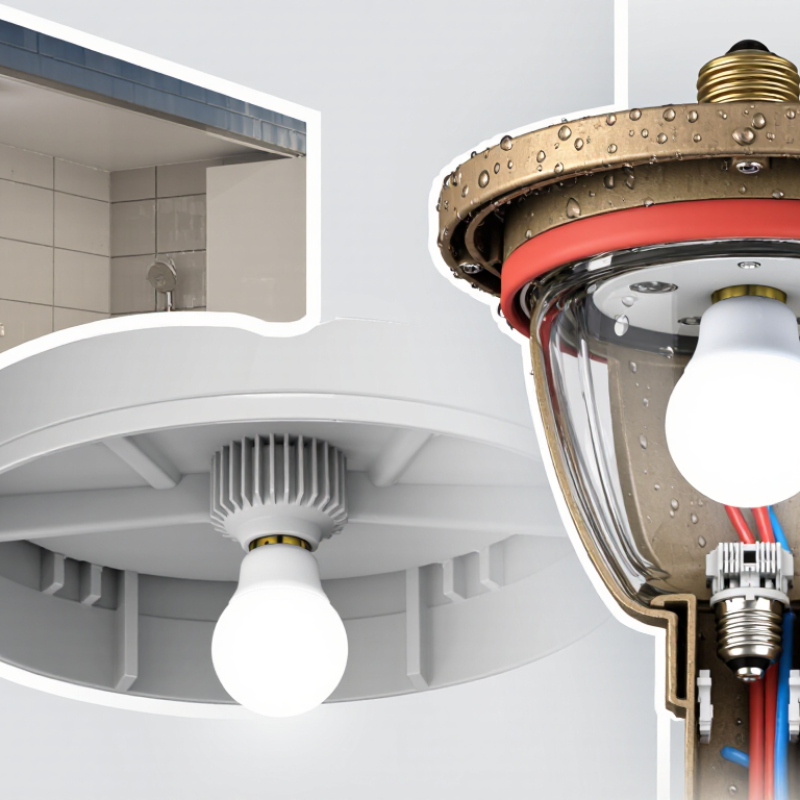
What Makes a Bulb Waterproof for Wet-Area Use?
A waterproof bulb is built to manage moisture without exposing energized parts. Its outer shell uses sealed glass or durable polymer around the LED components. Gaskets close small gaps near the base. These details help prevent water droplets from reaching the circuit board.
The fixture matters just as much. In wet areas, the socket should sit inside a sealed housing with suitable ingress protection. An IP rating indicates resistance to dust and water, but it does not make every bulb safe everywhere. A bulb rated for damp locations may tolerate bathroom humidity, while a wet-location model can handle direct splashes when installed correctly.
Installation changes the result. Keep the seal flat, tighten the cover evenly, and check for cracked lenses. Moisture can enter through a damaged gasket. It may also collect from condensation, especially after a hot shower. Small leaks are easy to miss.
The label is not a magic shield.
In practical inspections, the most common mistake is pairing a water-resistant bulb with an exposed socket. That combination creates a weak point. Power should be switched off before inspection, and local electrical requirements should guide the installation. Some products claim waterproof performance, yet their ratings apply only under specific mounting conditions. That limitation deserves attention. I would also replace any bulb showing fogging, corrosion, flickering, or dark marks, even if it still produces light. A working bulb is not always a safe bulb.
A bulb designed for wet areas uses sealed construction, moisture-resistant materials, and a suitable ingress protection rating. The second digit in an IP code describes water resistance: IPX4 protects against splashing, IPX5 against water jets, IPX6 against powerful water jets, IPX7 against temporary immersion up to 1 meter for 30 minutes, and IPX8 against continuous immersion under conditions specified by the manufacturer. Always match the bulb’s rating to the fixture and location requirements.
How Sealed Bulb Designs Block Water and Moisture
Waterproof bulbs rely on layered protection, not a single coating. A sealed housing surrounds the LED board, driver, and wiring connections. Silicone or EPDM gaskets compress against the lens and base. This pressure closes tiny paths where water could travel. In some designs, resin fills internal gaps around electrical parts. It feels excessive, but condensation can enter through surprisingly small spaces.
IEC 60529 defines IP ratings for dust and water resistance. An IP65 bulb resists water jets, while IP67 supports temporary immersion under specified test conditions. These ratings describe tested protection, not permanent immunity. The International Energy Agency reports that lighting uses about 15% of global electricity. Efficient sealed designs can protect that investment in wet garages, greenhouses, and outdoor fixtures.
Good installation still matters. The cable gland must grip tightly. The socket should face downward when possible, allowing droplets to run away. A cracked gasket can defeat the entire enclosure. Heat also creates a problem: when a bulb cools, internal air contracts and may draw humid air through weak seals. Pressure-equalizing membranes reduce this stress without leaving an open water path. They are useful, though not perfect. Regular inspection remains necessary, especially where salt spray, cleaning chemicals, or repeated temperature changes are present.
Waterproof bulbs rely on layered protection, not one magical material. A tough polycarbonate or borosilicate glass body resists impacts, heat, and splashing. Around the socket, silicone or EPDM gaskets press tightly against moisture. These elastomers stay flexible during temperature changes, although aging can create tiny gaps. Inside, a coated circuit board helps block condensation. Silicone potting compound may surround driver components, reducing corrosion and vibration. In practice, I inspect seals after installation, because a strong housing can still fail when the cable entry is loose. Water usually finds the weakest detail.
Metal parts need careful selection. Stainless steel screws resist rust better than ordinary steel. Nickel-plated contacts can slow oxidation near electrical connections. However, plating may wear during repeated assembly. Drainage and pressure equalization also matter. Trapped humidity can condense inside a sealed bulb after cooling. An IP rating provides useful test evidence, but it is not a permanent promise. Spray, immersion, and temperature tests cannot copy every balcony, bathroom, or coastal wall.
Tips: Keep cable glands above standing water when possible. Check gaskets for cuts, flattening, or grit. Do not drill extra holes into the housing. Let the bulb cool before washing it, since thermal shock can stress glass and seals. If condensation appears, disconnect power and investigate. I once underestimated a small cable bend. It pulled the gasket off-center. That mistake was avoidable.
Top 10 How Do Waterproof Bulbs Work in Wet Areas?
Waterproof bulbs are designed to limit water entry, but the bulb alone is not always enough. In bathrooms, porches, and damp utility rooms, the complete fixture must match the area’s moisture exposure. A sealed housing, gasket, and suitable ingress rating help protect electrical parts from splashes. “Waterproof” can be misleading. Some products resist spray, while others tolerate temporary immersion.
Heat remains a practical challenge. LEDs produce less heat than older lamps, but they still need airflow and a functioning heat sink. A metal body may draw heat away from the LED and spread it across the fixture. If insulation covers the fixture, heat can build up, shortening component life. I have seen moisture-safe installations fail early because heat management was ignored. The label did not tell the whole story.
Pressure and condensation create another problem. Outdoor fixtures warm during the day and cool at night, causing internal air to expand and contract. A pressure-equalizing membrane can reduce stress while blocking liquid water. It cannot stop every vapor cycle. Small droplets may still appear on a cold lens, especially after rain or a hot shower. Proper sealing, drainage paths, and correct installation reduce this risk. Local electrical requirements should guide placement and wiring. When instructions seem vague, that is a warning worth respecting.
| No. | Waterproofing Feature | How It Works | Heat Management | Pressure and Sealing | Condensation Control | Typical Wet-Area Use |
|---|---|---|---|---|---|---|
| 1 | IP-rated enclosure | The first IP digit describes protection against solids, while the second digit describes protection against water under IEC 60529 test conditions. | The enclosure must release heat through its body, heat sink, or permitted ventilation path without compromising the seal. | IPX4 generally indicates protection from splashing water; IPX5 indicates protection from water jets. Ratings apply to the tested assembly. | An IP rating limits water entry during specified tests, but it does not automatically mean the enclosure is completely vapor-proof. | Bathrooms, covered outdoor areas, utility rooms |
| 2 | Sealed lamp housing | A closed housing separates the LED board, driver, and electrical contacts from direct water and spray. | The housing normally transfers heat to its outer surface, where surrounding air removes it by convection and radiation. | Every joint, lens, and cable entry must remain sealed; a single damaged interface can reduce the effective protection. | A sealed cavity can still trap humid air. Cooling after operation may lower internal pressure and draw moisture through weak points. | Shower-room ceiling fixtures and enclosed exterior luminaires |
| 3 | Silicone or elastomer gaskets | Compressible gaskets fill microscopic gaps between the lens, housing, socket, and cover. | The gasket material must tolerate the lamp’s operating temperature without becoming brittle, permanently compressed, or deformed. | Even compression is essential. Over-tightening can distort a gasket, while under-tightening can create a leak path. | A gasket blocks liquid water but does not necessarily stop water vapor from migrating through the assembly over time. | Wet-location fixtures and outdoor wall lights |
| 4 | Water-resistant cable entries | Cable glands, compression fittings, and molded strain reliefs clamp around wiring and reduce the chance of water tracking into the enclosure. | The entry must not obstruct required heat-transfer surfaces or allow the cable seal to loosen as temperatures cycle. | Cable diameter must match the fitting range. Incorrect sizing can permit leaks even when the lamp housing is intact. | Correctly positioned entries help prevent water from pooling around the cable opening; downward-facing entries are often less exposed to runoff. | Exterior signs, patios, garages, washdown areas |
| 5 | LED heat sink | A metal heat sink spreads heat away from the LED junction and transfers it to the surrounding air. | LEDs produce less heat than incandescent lamps for comparable light output, but most electrical input still becomes heat rather than visible light. | A sealed waterproof cover can restrict airflow, so thermal design and the stated ambient-temperature limit are important. | Excess heat can increase temperature cycling, which may stress seals and encourage condensation during cool-down. | Enclosed bathroom, marine, and outdoor lighting |
| 6 | Pressure-equalization vent | A hydrophobic membrane can allow air and pressure changes to pass while resisting liquid water. | By reducing pressure differences, the vent can lessen stress on gaskets during heating and cooling cycles. | The vent must remain clean and undamaged. Blocking it with paint, dirt, or sealant can increase pressure stress or trap moisture. | Air exchange can help reduce pressure-driven moisture entry, but it does not remove water already inside the housing. | High-humidity outdoor and industrial environments |
| 7 | Anti-condensation design | Designs may use controlled ventilation, moisture-resistant materials, drainage paths, or low-moisture assembly processes. | Stable operating temperatures reduce repeated heating and cooling, which are common triggers for internal fogging. | Pressure changes caused by temperature variation can pull humid air through seals if the assembly is not designed for equalization. | Condensation occurs when a surface falls below the air’s dew point. A waterproof rating alone does not guarantee a fog-free lens. | Cold outdoor locations, saunas, humid rooms |
| 8 | Drainage and mounting orientation | Correct orientation prevents water from collecting near seams, lenses, connectors, and cable entries. | Keeping drainage and heat-transfer surfaces unobstructed helps the fixture operate closer to its intended thermal conditions. | Water pressure from sprays or runoff is easier to manage when the fixture is installed according to its instructions. | Drainage reduces standing water that can evaporate and raise humidity inside or around the enclosure. | Downlights, landscape lighting, exterior bulkhead fixtures |
| 9 | Protection against temporary immersion | An IPX7 test involves temporary immersion in water under defined laboratory conditions, commonly up to 1 meter for 30 minutes. | Immersion can sharply reduce air cooling, so the product must be specifically designed for the resulting thermal conditions. | IPX7 does not automatically include protection against pressurized water jets, which is covered by a different test level. | After immersion, trapped moisture may remain inside unless the enclosure is designed to dry or drain safely. | Low-level landscape fixtures and specified immersion applications |
| 10 | Wet-location installation compatibility | Safe performance depends on the complete lamp-and-fixture system, including the socket, wiring, mounting box, cover, and electrical protection. | The fixture must provide sufficient clearance and heat dissipation; an enclosed fixture can cause LED temperature and lifespan problems. | A waterproof bulb cannot correct a non-weatherproof socket, damaged wiring, poor junction box, or incorrectly sealed fixture. | Installation errors are a major source of water entry, fogging, corrosion, and electrical faults. | Any wet or damp location; follow local electrical requirements |
Note: IP ratings describe protection under defined test conditions and do not by themselves confirm suitability for every wet-area installation. Always check the complete fixture rating, operating-temperature limits, mounting instructions, and applicable electrical regulations.
Waterproof bulbs are not all designed for the same wet environment. A damp-rated bulb suits bathrooms, laundry rooms, and covered porches where moisture appears as humidity or light condensation. It should not face direct water. In these spaces, an enclosed LED fixture helps reduce corrosion and keeps moisture away from electrical contacts. The bulb still needs correct wattage and base size.
Wet-rated bulbs handle direct splashes and stronger exposure. They work best in open outdoor fixtures, shower enclosures approved for lighting, and areas near sprinklers. Look for a clear IP rating, such as IP65 or higher, instead of trusting the word “waterproof” alone. IP65 resists water jets, while IP67 offers temporary protection against immersion. Ratings apply to the complete fixture, not always the replacement bulb.
Placement changes the best choice. A sealed, low-temperature LED fixture works well above a steamy shower, but it may trap heat if poorly ventilated. Outdoor paths need weather-resistant housings, tight seals, and drainage. Check for fogging after use. Persistent moisture suggests a failed seal or unsuitable fixture, not merely a weak bulb. Local electrical rules also vary, so installation near water deserves review by a qualified electrician. I would not rely on appearance alone; even a bright, sturdy bulb can have unsafe contacts inside.
Its sealed outer shell helps keep moisture away from energized parts. Gaskets close gaps near the base. The fixture also needs protection.
Damp-rated bulbs handle humidity and light condensation. Wet-rated bulbs handle direct splashes when installed correctly. The wrong rating can create risks.
Usually, no. Shower areas may receive direct water. Use an approved wet-location fixture with suitable protection.
No. The rating may apply to the complete fixture, not the replacement bulb. Check the full installation conditions.
IP65 resists water jets. IP67 allows temporary immersion protection. Neither rating replaces correct mounting and sealing.
Turn off power before inspection. Keep the gasket flat and tighten the cover evenly. Check the lens for cracks.
Warm air may condense inside the fixture. Persistent fogging suggests a failed seal or poor suitability. Small leaks are easy to miss.
Replace bulbs showing fogging, corrosion, flickering, or dark marks. A glowing bulb is not always a safe bulb.
Choose a weather-resistant housing with tight seals and drainage. Avoid exposed sockets. Water needs somewhere to escape.
Yes, especially near showers or other water sources. Local electrical requirements vary. I would not trust appearance alone.
How do waterproof bulbs work in wet areas? They use sealed housings, protected sockets, and moisture-resistant materials to prevent water from reaching sensitive electrical components. Their outer covers and fitted seals create a barrier against splashes, humidity, and occasional water exposure, while insulated wiring and corrosion-resistant contacts help maintain safe, reliable operation. The level of protection depends on the bulb’s construction and intended environment.
A well-designed waterproof bulb must also manage heat, internal pressure, and condensation. Venting systems or carefully selected materials can reduce heat buildup without allowing moisture to enter, while durable lenses and housings help withstand changes in temperature. Different waterproof bulb types are suited to different wet areas, such as bathrooms, covered outdoor fixtures, utility spaces, or locations exposed to heavier splashing. Choosing the appropriate design ensures efficient lighting, longer service life, and safer performance in damp conditions.
